

Disassembly of Garments: A Review of Separation Technologies for Sewn, Welded and Bonded Joints
Authors
Annette KoellingFiles
Abstract
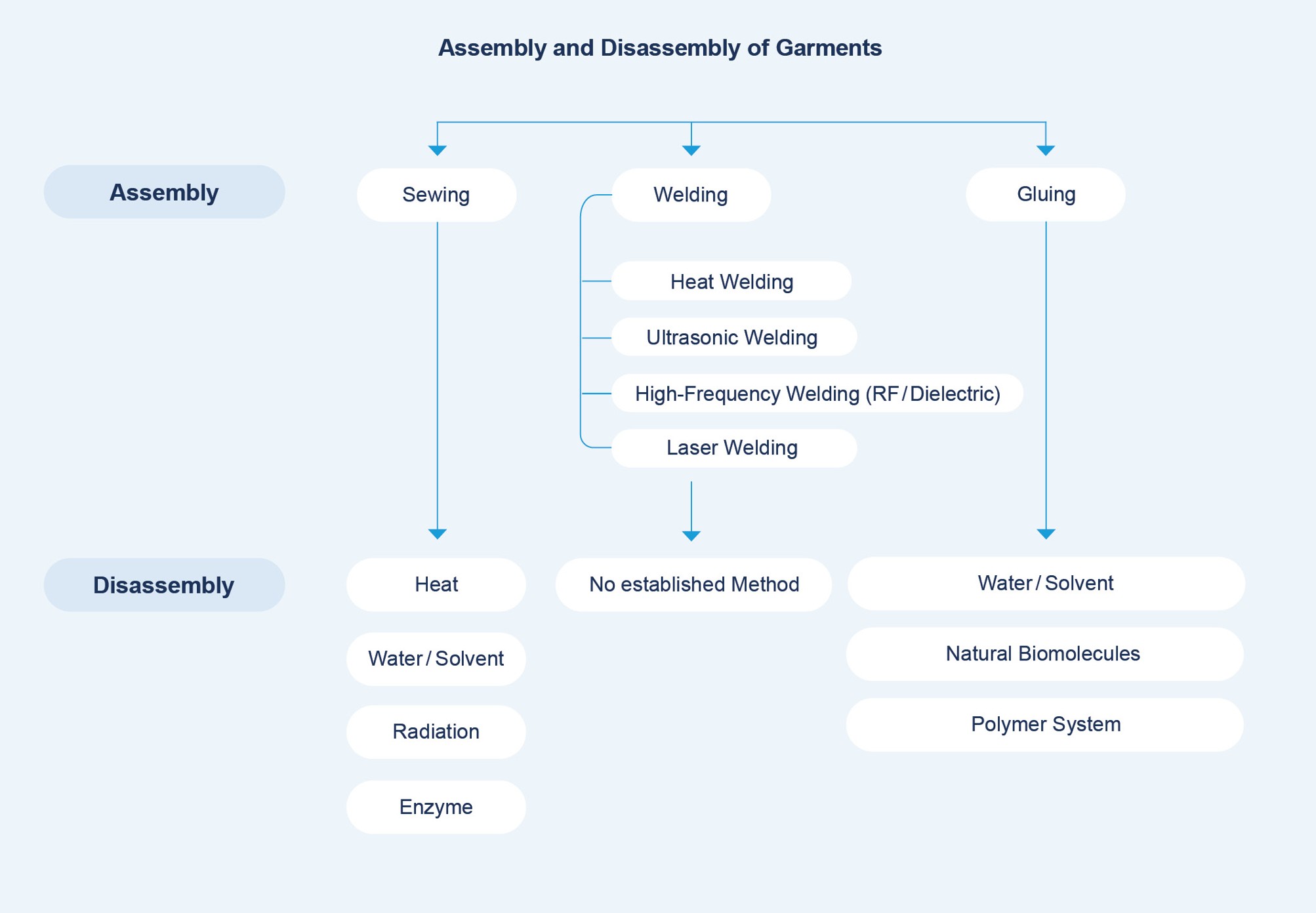
Textile waste continues to be a growing environmental problem that must be addressed by the textile industry. New products and production solutions are required according to the European Commission's Ecodesign Working Plan. Durability, reparability, and digital product passports are now regulated under the Ecodesign for Sustainable Products Regulation (ESPR), to support the transition toward a circular economy. Furthermore, the ability to disassemble a product at its end-of-life is expected to become an important requirement under the revised Waste Framework Directive in the coming years. To enhance the circularity of textile products, we must understand how these products are assembled, and based on that understanding, evaluate their disassembly. This review examines sewing, welding, and adhesive bonding of textiles, the three principal methods for assembling clothing, and evaluates their potential for controlled disassembly at end-of-life. Four thread-based assembly methods are discussed in this review, and the various triggers for disassembly are compared and analysed. Due to the material bond through polymer fusion during welding, the process is generally incompatible with reversible disassembly. Adhesive bonding is also considered a permanent process, which is being investigated in some initial material studies. The review shows that sewing has the highest potential for disassembly, however reversible thread systems remain limited. It identifies the lack of standardized testing procedures for seam strength and disassembly time as the most critical gap, which limits industrial scalability.
References
(1) Eberle, H. G. E. H. M. K. R. Fachwissen Bekleidung. In 12. Edition; Europa-Lehrmittel, 2022; pp 225,237-239.
(2) by Yordan Kyosev, E. Sewing Machines and Processes; 2024. https://doi.org/10.1201/9781003293071.
(3) Colovic, G. Sewing, Stitches and Seams. In Garment Manufacturing Technology; Elsevier, 2015; pp 247–273. https://doi.org/10.1016/B978-1-78242-232-7.00010-2.
(4) A NEW TEXTILES ECONOMY: REDESIGNING FASHION’S FUTURE.
(5) Kayalvizhi, C.; Gokarneshan, N. Evaluation of the Seam Quality in Garments; 2021; Vol. 9. www.ijres.org.
(6) Gurarda, A. Seam Performance of Garments; 2019. https://doi.org/http://dx.doi.org/10.5772/intechopen.86436.
(7) Hossain, N. T. Impact of Various Stitch Classes and Seam Types on Seam Strength. International Journal of Research and Innovation in Social Science (IJRISS) 2024. https://doi.org/10.47772/IJRISS.
(8) DIN Deutsches Institut für Normung e. V. Textiles — Stitch Types — Classification and Terminology. https://www.iso.org/obp/ui/en/#iso:std:iso:4915:ed-2:v1:en. April 2002.
(9) Jana, P. Assembling Technologies for Functional Garments-An Overview; 2011; Vol. 36. https://www.researchgate.net/publication/297687236.
(10) D’Itria, E.; Trejo Machin, A. Stitching Sustainability. Fashion Highlight 2024, No. 4, 138–147. https://doi.org/10.36253/fh-2912.
(11) Geissdoerfer, M.; Savaget, P.; Bocken, N. M. P.; Hultink, E. J. The Circular Economy – A New Sustainability Paradigm? Journal of Cleaner Production. Elsevier Ltd February 1, 2017, pp 757–768. https://doi.org/10.1016/j.jclepro.2016.12.048.
(12) Zapryanova, M.; Hacker, G. From Waste to Profit: cotton trousers designed for disassembly. www.resortecs.com (accessed 2025-08-19).
(13) Çiloğlu, E. Coats Water-Soluble Threads Contribute to Recycling in Textile. https://www.textilegence.com/en/coats-water-soluble-threads-contribute-to-recycling-in-textile/. December 6, 2021.
(14) © Coats Group plc 2025. Coats EcoCycleTM. https://www.coats.com/en/products/threads/ecocycle/ecocycle/ (accessed 2025-08-20).
(15) WEAR2GO B.V. Wear2 ® Microwave technology. https://wear2.com/en/corporate-workwear/wear2-microwave-technology/ (accessed 2025-08-20).
(16) Durham, E.; Hewitt, A.; Rea, C.; Russell, S. Seam Separation Technology to Facilitate Re-Use and Recycling of Textile Products; 2014. http://www.inimpact.org.
(17) Egan, J.; Wang, S.; Shen, J.; Baars, O.; Moxley, G.; Salmon, S. Enzymatic Textile Fiber Separation for Sustainable Waste Processing. Resources, Environment and Sustainability 2023, 13. https://doi.org/10.1016/j.resenv.2023.100118.
(18) Lehmann, M.; Herrmann, M. Enzyme-Displaying Spores as a Novel Strategy for Mixed Fiber Textile Recycling. Frontiers in Systems Biology. Frontiers Media SA 2025. https://doi.org/10.3389/fsysb.2025.1603731.
(19) Navone, L.; Moffitt, K.; Hansen, K. A.; Blinco, J.; Payne, A.; Speight, R. Closing the Textile Loop: Enzymatic Fibre Separation and Recycling of Wool/Polyester Fabric Blends. Waste Management 2020, 102, 149–160. https://doi.org/10.1016/j.wasman.2019.10.026.
(20) Serdar, S. G. Non-Stitch Joining Methods in Textile. Trends in Textile Engineering & Fashion Technology 2023, 8 (5). https://doi.org/10.31031/tteft.2023.08.000696.
(21) Jones, I. Ultrasonic and Dielectric Welding of Textiles. In Joining Textiles: Principles and Applications; Elsevier Ltd., 2013; pp 374–397. https://doi.org/10.1533/9780857093967.3.374.
(22) PFAFF. PFAFF Welding Machines. www.pfaff-industrial.com (accessed 2025-08-31).
(23) SealWerks. What is Radio Frequency (RF) Welding? https://radiofrequencywelding.com/what-is-radio-frequency-welding/ (accessed 2025-12-09).
(24) Henry Royce Institute. CEAMS CASE STUDY Towards a Circular Economy in Textiles: Designing Sustainable Adhesives for Garment Bonding; 2025. https://www.royce.ac.uk/research/impact/towards-a-circular-economy-in-textiles-designing-sustainable-adhesives-for-garment-bonding/ (accessed 2025-09-09).
(25) MacKinnon, D. J.; Liu, Y.; Becer, C. R. Thermoreversible Apparel Adhesives to Enable Sustainable Garment Assembly. Adv Mater Interfaces 2025, 12 (6). https://doi.org/10.1002/admi.202400685.
(26) CreateMe Technologies, Inc. Thermo(re)set is a paradigm shift towards circular fashion. 2025. https://www.createme.com/thermo-reset (accessed 2025-09-10).
(27) Conagen Develops Sustainable Debondable Adhesive for Textiles, Revolutionizing Clothing Production
(18) Lehmann, M.; Herrmann, M. Enzyme-Displaying Spores as a Novel Strategy for Mixed Fiber Textile Recycling. Frontiers in Systems Biology. Frontiers Media SA 2025. https://doi.org/10.3389/fsysb.2025.1603731.
(19) Navone, L.; Moffitt, K.; Hansen, K. A.; Blinco, J.; Payne, A.; Speight, R. Closing the Textile Loop: Enzymatic Fibre Separation and Recycling of Wool/Polyester Fabric Blends. Waste Management 2020, 102, 149–160. https://doi.org/10.1016/j.wasman.2019.10.026.
(20) Serdar, S. G. Non-Stitch Joining Methods in Textile. Trends in Textile Engineering & Fashion Technology 2023, 8 (5). https://doi.org/10.31031/tteft.2023.08.000696.
(21) Jones, I. Ultrasonic and Dielectric Welding of Textiles. In Joining Textiles: Principles and Applications; Elsevier Ltd., 2013; pp 374–397. https://doi.org/10.1533/9780857093967.3.374.
(22) PFAFF. PFAFF Welding Machines. www.pfaff-industrial.com (accessed 2025-08-31).
(23) SealWerks. What is Radio Frequency (RF) Welding? https://radiofrequencywelding.com/what-is-radio-frequency-welding/ (accessed 2025-12-09).
(24) Henry Royce Institute. CEAMS CASE STUDY Towards a Circular Economy in Textiles: Designing Sustainable Adhesives for Garment Bonding; 2025. https://www.royce.ac.uk/research/impact/towards-a-circular-economy-in-textiles-designing-sustainable-adhesives-for-garment-bonding/ (accessed 2025-09-09).
(25) MacKinnon, D. J.; Liu, Y.; Becer, C. R. Thermoreversible Apparel Adhesives to Enable Sustainable Garment Assembly. Adv Mater Interfaces 2025, 12 (6). https://doi.org/10.1002/admi.202400685.
(26) CreateMe Technologies, Inc. Thermo(re)set is a paradigm shift towards circular fashion. 2025. https://www.createme.com/thermo-reset (accessed 2025-09-10).
(27) Conagen Develops Sustainable Debondable Adhesive for Textiles, Revolutionizing Clothing Production and Recycling. Technical Textiles Today. https://www.technicaltextiles.in/conagen-develops-sustainable-debondable-adhesive-for-textiles-revolutionizing-clothing-production-and-recycling/ (accessed 2025-09-10).
Details


License
Copyright (c) 2026 Annette Koelling

This work is licensed under a Creative Commons Attribution 4.0 International License.