

Digital Deconstruction Project – exploring the possibilities of re-designing digital designs for more sustainability
Authors
Annette KoellingFiles
Abstract
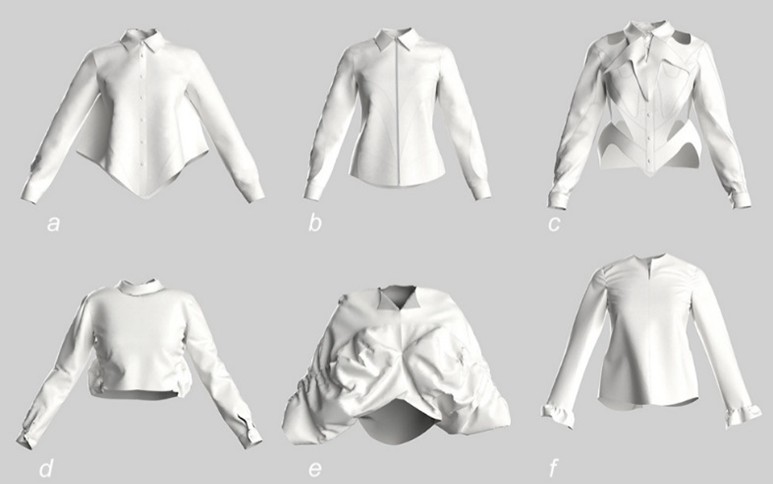
The fashion industry is in a critical state of overproduction and overconsumption, often disregarding any social or environmental concerns. Pre-consumer waste, including unworn and unsold garments such as leftover stock, represents up to one third of total production and is regularly landfilled or incinerated. This study presents early-stage research whether AI-automated design suggestions can be developed using pre-consumer waste from unworn garments. The Digital Deconstruction Project is a preliminary study conducted at the Hochschule Hannover, University of Applied Sciences and Arts with a team of seven students. It explores the possibility of creating new, appealing designs from existing pattern- such as a classic women’s shirt, which in this study represents overproduced clothing - while minimizing waste using the computer-aided design system Clo3D. The focus is on determining how many of the existing pattern pieces can be re-used, creating as little waste as possible. The starting point of this project was a pattern block from the modular library of Clo3D, which is generally accessible within the software. The finding indicates that it is indeed possible to redesign a CAD file of an existing garment, the developed design results range from wearable-commercial to very fashionable. However, future iterations of this study should aim to reduce material waste even further. It is suggested to start with a simpler pattern block or a zero-waste pattern system to validate the concept of digital deconstruction. Next steps will involve investigating effective methods for connecting multiple designs to a single pattern and solving the first steps in the automating processes.
References
Niinimäki, K.; Peters, G.; Dahlbo, H.; Perry, P.; Rissanen, T.; Gwilt, A. The Environmental Price of Fast Fashion. Nature Reviews Earth and Environment. Springer Nature April 1, 2020, pp 189–200. https://doi.org/10.1038/s43017-020-0039-9.
(2) Mowbray, J. One third of all clothing “never sold.” Ecotextile News. https://www.ecotextile.com/2016042132802/news/fashion-retail/one-third-of-all-clothing-never-sold/ (accessed 2025-06-08).
(3) Siliņa, L.; Dāboliņa, I.; Lapkovska, E. Sustainable Textile Industry – Wishful Thinking or the New Norm: A Review. Journal of Engineered Fibers and Fabrics. SAGE Publications Ltd January 1, 2024. https://doi.org/10.1177/15589250231220359.
(4) A NEW TEXTILES ECONOMY: REDESIGNING FASHION’S FUTURE.
(5) Dissanayake, G.; Sinha, P. Sustainable Waste Management Strategies in the Fashion Industry Sector. International Journal of Environmental Sustainability 2013, 8 (1), 77–90. https://doi.org/10.18848/2325-1077/cgp/v08i01/55036.
(6) Wulff, G. The Challenge of Overproduction and Overconsumption. In The Future of Consumption: How Technology, Sustainability and Wellbeing will Transform Retail and Customer Experience; Springer International Publishing, 2023; pp 205–223. https://doi.org/10.1007/978-3-031-33246-3_13.
(7) Deckers, J.; Duhoux, T. Textile Waste Management in Europe’s Circular Economy. Technical Report 2024. https://doi.org/10.13140/RG.2.2.18572.53122.
(8) Sawhney, M. K. Latest Trends in Textile and Fashion Designing Zero Waste Fashion: Exploring Zero-Waste Pattern Cutting to Eliminate Fabric Waste in the Garment Manufacturing Industry. 2023. https://doi.org/10.32474/LTTFD.2023.06.000226.
(9) Gam, H. J. Rissanen, T., & McQuillan, H. (2016). Zero Waste Fashion Design. London; New York: Fairchild Books, an Imprint of Bloomsbury Publishing, Plc, [2016]. ISBN 978‐1‐4725‐8198‐3. 223 Pp. Fam Consum Sci Res J 2018, 46 (3), 314–316. https://doi.org/10.1111/fcsr.12255.
(10) Harsanto, B.; Primiana, I.; Sarasi, V.; Satyakti, Y. Sustainability Innovation in the Textile Industry: A Systematic Review. Sustainability (Switzerland). MDPI January 1, 2023. https://doi.org/10.3390/su15021549.
(11) European Commission. Closing the loop - An EU action plan for the Circular Economy COM/2015/0614 final. https://eur-lex.europa.eu/legal-content/EN/TXT/?uri=CELEX:52015DC0614 (accessed 2025-06-10).
(12) Kappahl, S. R.; Sandin, G.; Peters, G.; Schwarz Bour, L. White Paper on Textile Recycling. 2019. https://doi.org/10.13140/RG.2.2.31018.77766.
(13) Sandin, G.; Peters, G. M. Environmental Impact of Textile Reuse and Recycling – A Review. Journal of Cleaner Production. Elsevier Ltd May 20, 2018, pp 353–365. https://doi.org/10.1016/j.jclepro.2018.02.266.
(14) Schumacher, K.; Forster, A. L. Facilitating a Circular Economy for Textiles Workshop Report; 2022. https://doi.org/10.6028/NIST.SP.1500-207.
(15) Huang, G.; Shi, S.; Wang, Q.; Li, F.; Li, X.; Liu, F.; Lu, Z. Carbon Footprint Assessment and Reconstruction Redesign of Recycled Discarded Military Training Uniforms. Sci Rep 2025, 15 (1). https://doi.org/10.1038/s41598-025-87733-x.
(16) Haq, U. N.; Alam, S. M. R. Implementing Circular Economy Principles in the Apparel Production Process: Reusing Pre-Consumer Waste for Sustainability of Environment and Economy. Cleaner Waste Systems 2023, 6. https://doi.org/10.1016/j.clwas.2023.100108.
(17) Oliveira Neto, G. C. de; Santos, R. A. R.; Pinto, L. F. R.; Flausino, F. R.; Oliveira, D. E. P. de; Seri, M. N. Innovative Circular Practices Integrating Business Model for Textile Industry. Journal of Engineered Fibers and Fabrics. SAGE Publications Ltd January 1, 2024. https://doi.org/10.1177/15589250241226481.
(18) Plumb, J. Designing for a Circular Economy. Cambridge Design Technology. https://www.cambridge-dt.com/designing-for-a-circular-economy-reducing-waste-and-enabling-sustainable-design-practices/#:~:text=The%20Role%20of%20Product%20Design%20in%20Enabling,create%20products%20that%20facilitate%20reuse%20and%20repair. (accessed 2025-06-09).
(19) Aus, R.; Moora, H.; Vihma, M.; Unt, R.; Kiisa, M.; Kapur, S. Designing for Circular Fashion: Integrating Upcycling into Conventional Garment Manufacturing Processes. Fashion and Textiles 2021, 8 (1). https://doi.org/10.1186/s40691-021-00262-9.
(20) Anjimoon, S.; Asha, V.; Gurnani, J.; Khan, I.; Paul, S.; Al-Jawahry, H. M. Innovations and Opportunities in Sustainable Textile Recycling. In E3S Web of Conferences; EDP Sciences, 2024; Vol. 507. https://doi.org/10.1051/e3sconf/202450701065.
(21) Tiwari, S.; Patel, M. P. Fashion Sustainability: Exploring Recycle, Reuse, And Reduce Practices; 2024. www.ijcrt.org.
(22) FTR, F. T. H&M gründet Recyclingfirma Syre für das Textil-zu-Textil-Recycling von Polyester. https://www.bvse.de/gut-informiert-textil-recycling/nachrichten/10577-h-m-gruendet-recyclingfirma-syre-fuer-das-textil-zu-textil-recycling-von-polyester.html (accessed 2025-06-10).
(23) Eppinger, E. Recycling Technologies for Enabling Sustainability Transitions of the Fashion Industry: Status Quo and Avenues for Increasing Post-Consumer Waste Recycling. Sustainability: Science, Practice, and Policy 2022, 18 (1), 114–128. https://doi.org/10.1080/15487733.2022.2027122.
(24) Tang, K. H. D. State of the Art in Textile Waste Management: A Review. Textiles. Multidisciplinary Digital Publishing Institute (MDPI) December 1, 2023, pp 454–467. https://doi.org/10.3390/textiles3040027.
(25) Abrishami, S.; Shirali, A.; Sharples, N.; Kartal, G. E.; Macintyre, L.; Doustdar, O. Textile Recycling and Recovery: An Eco-Friendly Perspective on Textile and Garment Industries Challenges. Textile Research Journal. SAGE Publications Ltd December 1, 2024. https://doi.org/10.1177/00405175241247806.
(26) Extended Producer Responsibility A GUIDANCE MANUAL FOR GOVERNMENTS.
(27) Zhikun Li; Zhou, Y.; Zhao, M.; Guan, D.; Yang, Z. The Carbon Footprint of Fast Fashion Consumption and Mitigation Strategies-a Case Study of Jeans. Science of The Total Environment 2024. https://doi.org/doi.org/10.1016/j.scitotenv.2024.171508.
(28) Gill, A. Deconstruction Fashion: The Making of Unfinished, Decomposing and Re-Assembled Clothes Introduction: Deconstruction “In Fashion”; 1998; Vol. 2.
(29) Jevšnik, S. 3D Virtual Prototyping of Garments: Approaches, Developments and Challenges. Journal of Fiber Bioengineering and Informatics 2017, 10 (1), 51–63. https://doi.org/10.3993/jfbim00253.
(30) Zhao, L.; Liu, S.; Zhao, X. Big Data and Digital Design Models for Fashion Design. Journal of Engineered Fibers and Fabrics. SAGE Publications Ltd 2021. https://doi.org/10.1177/15589250211019023.
(31) Riedelsheimer, T.; Dorfhuber, L.; Stark, R. User Centered Development of a Digital Twin Concept with Focus on Sustainability in the Clothing Industry. In Procedia CIRP; Elsevier B.V., 2020; Vol. 90, pp 660–665. https://doi.org/10.1016/j.procir.2020.01.123.
(32) Franciosi, C.; Miranda, S.; Veneroso, C. R.; Riemma, S. Improving Industrial Sustainability by the Use of Digital Twin Models in Maintenance and Production Activities. In IFAC-PapersOnLine; Elsevier B.V., 2022; Vol. 55, pp 37–42. https://doi.org/10.1016/j.ifacol.2022.09.215.
(33) E, P.; N, B. 3D Virtual Prototyping Traces New Avenues for Fashion Design and Product Development: A Qualitative Study. J Text Sci Eng 2017, 07 (02). https://doi.org/10.4172/2165-8064.1000297.
(34) Mesjar, L.; Cross, K.; Jiang, Y.; Steed, J. The Intersection of Fashion, Immersive Technology, and Sustainability: A Literature Review. Sustainability (Switzerland). MDPI February 1, 2023. https://doi.org/10.3390/su15043761.
(35) Rissanen, T. ZEROWASTE FASHION DESIGN: A Study at the Intersection of Cloth, Fashion Design and Pattern Cutting.
(36) Progress towards Preventing Waste in Europe-the Case of Textile Waste Prevention. 2021. https://doi.org/10.2800/494502.
(37) McQuillan, H. Digital 3D Design as a Tool for Augmenting Zero-Waste Fashion Design Practice. International Journal of Fashion Design, Technology and Education 2020, 13 (1), 89–100. https://doi.org/10.1080/17543266.2020.1737248.
(38) Hwang, G. Y.; Lee, Y. What Is the Next Step for Zero-Waste Fashion? International Journal of Costume and Fashion 2023, 23 (2), 45–57. https://doi.org/10.7233/ijcf.2023.23.2.045.
(39) Zhang, R.; Mueller, S.; Bernstein, G. L.; Schulz, A.; Leake, M. WasteBanned: Supporting Zero Waste Fashion Design Through Linked Edits. In Proceedings of the 37th Annual ACM Symposium on User Interface Software and Technology; ACM: New York, NY, USA, 2024; pp 1–13. https://doi.org/10.1145/3654777.3676395.
(40) Shatarah, S. M. Kurdish Studies Zero-Waste Pattern Making: Revolutionizing Sustainable Apparel Design and Production. 2023. https://doi.org/10.58262/ks.v11i3.054.
(41) Grasheli, K.; Andhini, R. D.; Paramita, J. Implementing Zero Waste Pattern Cutting for Sustainable Fashion Collection; 2022.
(42) Marin, I. E. Research Regarding New Sustainable Methods of Garment Pattern Drafting. Journal of Textile Engineering & Fashion Technology 2022, 8 (4), 140–143. https://doi.org/10.15406/jteft.2022.08.00312.
(43) Habib, Md. A.; Alam, Md. S. A Comparative Study of 3D Virtual Pattern and Traditional Pattern Making. Journal of Textile Science and Technology 2024, 10 (01), 1–24. https://doi.org/10.4236/jtst.2024.101001.
(44) Widiyawati, I.; Prasetya, L. A.; Permataningtyas, A.; Nurhadi, D.; Hidayati, N.; Ichwanto, M. A. Application of Clo3d Technology in Fashion Vocational Education in Vocational Schools: A Systematic Literature Review. IJECA (International Journal of Education and Curriculum Application) 2024, 7 (3), 268. https://doi.org/10.31764/ijeca.v7i3.26216.
Details


License
Copyright (c) 2025 Annette Koelling

This work is licensed under a Creative Commons Attribution 4.0 International License.