
3D woven near-net-shape preforms for CMC airfoils
Authors
Silke Grosch, Daniela Albert, Christian Eckardt, Ralf Herborn, Heiko Ziebold, Aurelia Bauer, Recep Türkay Kocaman, Frank FickerFiles
Abstract
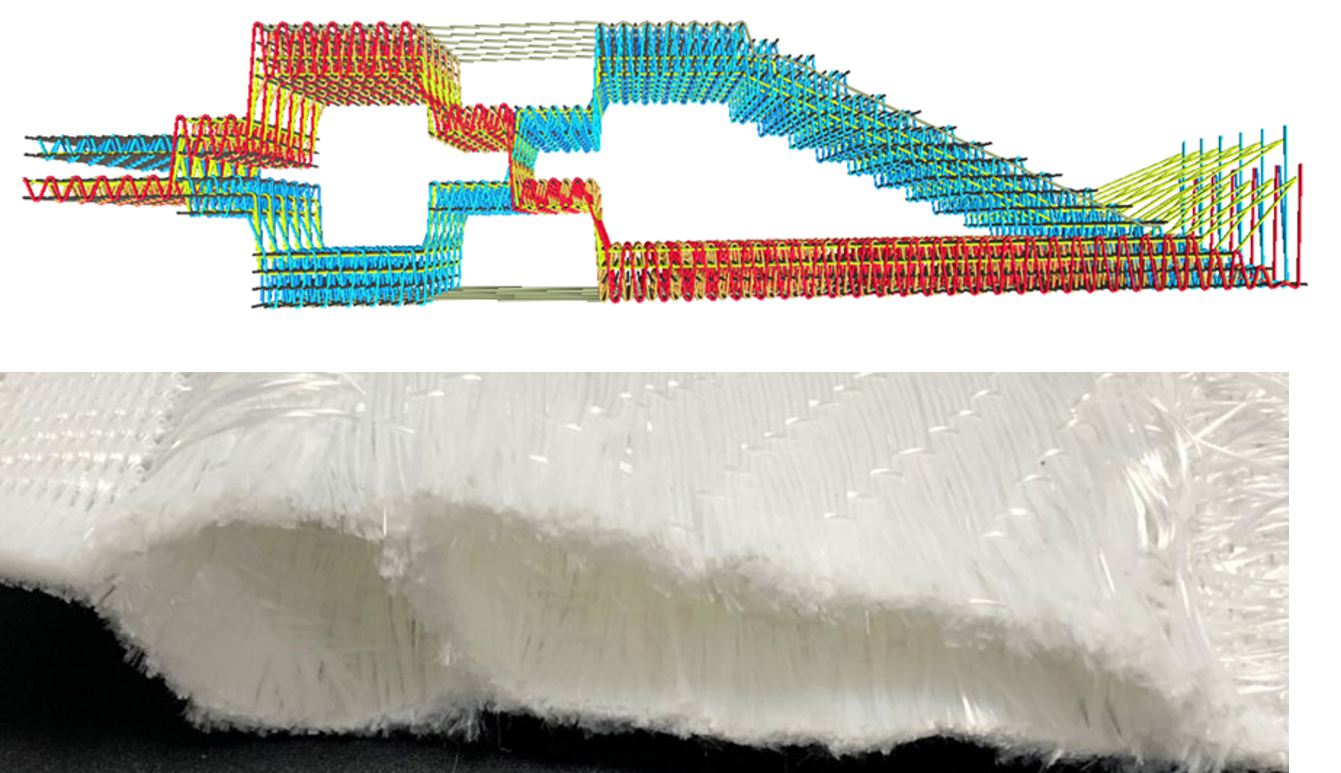
Traditionally, high-density metallic airfoils are used in aircraft engines. Ceramic materials are much lighter and can operate at higher temperatures. However, as a monolithic material, they are not suitable for high reliability applications due to excessive brittle fracture behavior. By reinforcing ceramics with ceramic fiber structures, it is possible to increase fracture toughness and damage tolerance significantly. These CMC (Ceramic Matrix Composites) are one of the materials of the future due to their high strength, dynamic load capacity, thermal shock resistance and resistance to aggressive media in the high-temperature range. An efficient production of the textile preforms, which are required for CMC parts, is a prerequisite to bring them into widespread industrial use. This article describes the development of near-net-shape, load-path 3D woven structures made of ceramic materials that can be mass-produced on industrial equipment and optimally comply with the subsequent process of ceramic matrix insertion. Based on the simulation of two assumed load cases, the optimum structural design is determined. A multi-layer structure of the base fabric is used to achieve the required component thickness of 2-3 mm. In iterative infiltration tests, the optimum structure for the matrix injection is found using a pressure-assisted infiltration technique.
References
Halbig MC, Jaskowiak MH, Kiser JD, Zhu D; Evaluation of Ceramic Matrix Composite Technology for Aircraft Turbine Engine Applications, NASA Glenn Research Center, Cleveland, OH 44135, (2013).
Nestler, D.J.: Contribution to the topic: Composite materials. Status quo and research approaches, Habilitation 2013, Universitätsverlag Chemnitz, 2014, ISBN 978-3-944640-12-9 and http://nbn-resolving.de/urn:nbn:de:bsz:ch1-qucosa-134459
W. Krenkel, J. Lamon (Eds.), High Temperature Ceramic Materials and Composites: Manufacture and Characterization of OXIPOL Based on Different Oxide Fibers, AVISO Verlagsgesellschaft mbH, Berlin, (2010).
Schmidt, J.; Eckardt, C.; Rüdinger, A.: Lightweight Hot Structures from Oxide Ceramic Matrix Composites, CFI Ceramic Forum International, 6/2022, S. E39-E44.
M. Kienbaum, Bindungstechnik der Gewebe - Band 3: Dreher-, Falten-, Flor- und Jacquardgewebe, 2. Auflage, WeaveStruct Verlag - CH-Consulting, Goldkronach, (2019).
C. Cherif, Textile Werkstoffe für den Leichtbau: Techniken - Verfahren - Materialien - Eigenschaften, Springer-Ver-lag Berlin Heidelberg, Berlin, Heidelberg, (2011).
A.R. Torun, Advanced manufacturing technology for 3D profiled woven preforms: Dissertation, Dresden, (2011).
A. Mountasir, Entwicklung einer flexiblen Webtechnologie zur Fertigung integral gewebter 3D Halbzeuge für Fa-serkunststoffbauteile komplexer Geometrie: Dissertationsschrift, Dresden, (2015).
N.P. Bansal, J. Lamon (Eds.), Ceramic matrix composites - Materials, modeling and technology: Oxide-Oxide Composites, Wiley, Hoboken, (2015).
H.P. Degischer (Ed.), 14. Symposium Verbundwerkstoffe und Werkstoffverbunde: Langfaserverstärkte oxidkeramische Verbundwerkstoffe nach dem LPI-Verfahren, Wiley-VCH, Weinheim, (2003).
G. Puchas, A. Held, W. Krenkel, Near-net shape manufacture process for oxide fiber composites (OFC), Materials Today: Pro-ceedings 49–58 (2019).
Wachtman J. B. (Ed.), Proceedings of the 18th Annual Conference on Composites and Advanced Ceramic Materials - A: 3-D Composite Fabrication through Matrix Slurry Pressure Infiltration, The American Ceramic Society, Westerville (OH), (1994).
P. Jahn, B. Mussler, M. Rabenstein, W. Rieß, C. Eckardt, J. Lehmann et al., Druckschlickerguss Technischer Keramik, Ceramic Forum International 307–311, (2005).
Details


License
Copyright (c) 2025 Silke Grosch, Daniela Albert, Christian Eckardt, Ralf Herborn, Heiko Ziebold, Aurelia Bauer, Recep Türkay Kocaman, Frank Ficker

This work is licensed under a Creative Commons Attribution 4.0 International License.