

Natural dyeing of algae fibers: Toward fully bio-based textiles
Authors
Malinda Halamba Arachchige, Leon Blanckart, Clara Heil, Karin Ratovo, Abdelfatah Abomohra, Ellen Bendt, Boris MahltigFiles
Abstract
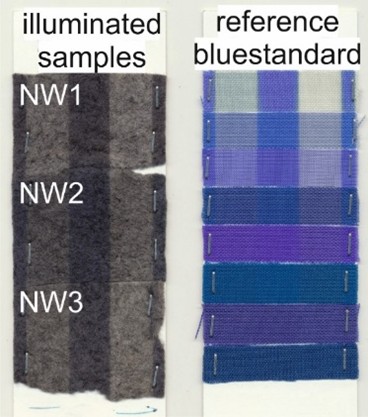
Conventionally natural fibers are sourced from plant or animals. Additional to these terrestric sources, natural fibers can be also gained from aquatic sources like algae. Filamentous algae species offer the chance for the development of a new type of natural fiber which can be sourced sustainable and without extensive land use. However, the development of a fully sustainable fiber material requires additionally to the fiber also the development of a sustainable coloration. With this background, the scope of the current study is to demonstrate a natural dyeing procedure for coloration of algae fiber materials. For this purpose, the dyeing with logwood extracts in combination with different iron mordanting processes are evaluated. Finally, dark/grey to black coloration are realized on the algae fibers. The wash fastness and light fastness exhibit medium to good grades for natural dye application. These promising results provide a clear prove-of-concept and offer the chance for development of a new type of sustainable fiber materials – colored algae fibers.
References
References
Slama, H.B.; Chenari Bouket, A.; Pourhassan, Z.; Alenezi, F.N.; Silini, A.; Cherif-Silini, H.; Oszako, T.; Luptakova, L.; Golinska, P.; Belbahri, L. Diversity of synthetic dyes from textile industries, discharge impacts and treatment methods. Applied Sciences 2021, 11(14), 6255. doi.org/10.3390/app11146255
Fobiri, G. K. Synthetic dye application in textiles: A review on the efficacies and toxicities involved. Textile & Leather Review 2022, 5, 180-198. doi.org/10.31881/TLR.2022.22
Islam, M.T.; Islam, T.; Islam, T.; Repon, M. R. Synthetic dyes for textile colouration: Process, factors and environmental impact. Textile and Leather Review 2022, 5, 327-373. doi.org/10.31881/TLR.2022.27
Khatri, A.; Peerzada, M.H.; Mohsin, M.; White, M. A review on developments in dyeing cotton fabrics with reactive dyes for reducing effluent pollution. Journal of Cleaner Production 2015, 87, 50-57. doi.org/10.1016/j.jclepro.2014.09.017
Hoque, M.T.; Benrui, T.; Grethe, T.; Mahltig, B. Evaluation of chitosan based pretreatment for cotton and linen dyeing with direct dyes and reactive dyes. Communications in Development and Assembling of Textile Products - CDATP 2023, 4(2), 187-200. doi.org/10.25367/cdatp.2023.4.p187-200
Koh, J.; Sim, G.; Kim, J. pH control in the dyeing of polyamide with acid dyes. Coloration Technology 2001, 117(3), 156-160. doi.org/10.1111/j.1478-4408.2001.tb00055.x
Aspland, J.R. Disperse dyes and their application to polyester. Textile Chemist and Colorist 1992, 24(12), 18-23.
Yaseen, D.A.; Scholz, M. Textile dye wastewater characteristics and constituents of synthetic effluents: a critical review. International Journal of Environmental Science & Technology 2019, 16(2), 1193-1226. doi.org/10.1007/s13762-018-2130-z
Slama, H.B.; Chenari Bouket, A.; Pourhassan, Z.; Alenezi, F.N.; Silini, A.; Cherif-Silini, H.; Oszako, T.; Luptakova, L.; Golinska, P.; Belbahri, L. Diversity of synthetic dyes from textile industries, discharge impacts and treatment methods. Applied Sciences 2021, 11(14), 6255. doi.org/10.3390/app11146255
Ismail, M.; Akhtar, K.; Khan, M.I.; Kamal, T.; Khan, M.A. M Asiri, A.; Seo, J.; Khan, S.B. Pollution, toxicity and carcinogenicity of organic dyes and their catalytic bio-remediation. Current Pharmaceutical Design 2019, 25(34), 3645-3663. DOI:10.2174/1381612825666191021142026
Gita, S.; Hussan, A.; Choudhury, T.G. Impact of textile dyes waste on aquatic environments and its treatment. Environment & Ecology 2017, 35(3C), 2349-2353.
Ali, H. Biodegradation of synthetic dyes—a review. Water, Air, & Soil Pollution 2010, 213(1), 251-273. doi.org/10.1007/s11270-010-0382-4
Negi, A. Environmental impact of textile materials: challenges in fiber–dye chemistry and implication of microbial biodegradation. Polymers 2025, 17(7), 871. doi.org/10.3390/polym17070871
Mabuza, L.; Sonnenberg, N.; Marx-Pienaar, N. Natural versus synthetic dyes: Consumers’ understanding of apparel coloration and their willingness to adopt sustainable alternatives. Resources, Conservation & Recycling Advances 2023, 18, 200146. doi.org/10.1016/j.rcradv.2023.200146
Pizzicato, B.; Pacifico, S.; Cayuela, D.; Mijas, G.; Riba-Moliner, M. Advancements in sustainable natural dyes for textile applications: a review. Molecules 2023, 28(16), 5954. doi.org/10.3390/molecules28165954
Negi, A. Natural dyes and pigments: Sustainable applications and future scope. Sustainable Chemistry 2025, 6(3), 23. doi.org/10.3390/suschem6030023
Santiago, D.; Cunha, J.; Cabral, I. Chromatic and medicinal properties of six natural textile dyes: a review of eucalyptus, weld, madder, annatto, indigo and woad. Heliyon 2023, 9, e22013. doi.org/10.1016/j.heliyon.2023.e22013
Schenek, A. Naturfaser Lexikon; Deutscher Fachverlag GmbH: Frankfurt am Main, Germany, 2000.
Chen, F.; Ji, X.; Chu, J.; Xu, P.; Wang, L. A review: life cycle assessment of cotton textiles. Industria Textila 2021, 72(1), 19-29.
Zhang, Y.Q.; Lykaki, M.; Alrajoula, M.T.; Markiewicz, M.; Kraas, C.; Kolbe, S.; Klinkhammer, K.; Rabe, M.; Klauer, R.; Stolte, S. Microplastics from textile origin–emission and reduction measures. Green Chemistry 2021, 23(15), 5247-5271. doi.org/10.1039/D1GC01589C
Blanckart, L.; Ratovo, K.; Mahltig, B.; Bendt, E. Aquatic natural fibers as a new raw material with potential for the textile industry. Melliand International 2023, 28(4), 20-22.
Rahaman, A.; Blanckart, L.; Hanelt, D.; Poller, M.J.; Heil, C.; Prova, S.M.; Ratovo, K.; Bendt, E.; Mahltig, B.; Abomohra, A. Unraveling filamentous algae as a renewable bioresource for advanced moisture-absorbent innovative aquatic fibers. Bioresources and Bioprocessing 2026, 13, 33. doi.org/10.1186/s40643-026-01028-1
Sun, J.; Tan, H. Alginate-based biomaterials for regenerative medicine applications. Materials 2013, 6(4), 1285-1309. doi.org/10.3390/ma6041285
Ma, B.; Hou, X.; He, C. Preparation of chitosan fibers using aqueous ionic liquid as the solvent. Fibers and Polymers 2015, 16(12), 2704-2708. DOI 10.1007/s12221-015-5638-6
Rahaman, A.; Hanelt, D.; von Schwartzenberg, K.; Abomohra, A. Unveiling the potential of freshwater filamentous algae as a promising alternative source of essential fatty acids and bioactive carotenoids. Algal Research 2025, 89, 104100. doi.org/10.1016/j.algal.2025.104100
Adaschewski, E.; Poller, M.J.; Hanelt, D.; Abomohra, A. Enhanced micro-and nanoplastic (MNP) removal by easy-harvestable filamentous algae with indications of plastic surface transformation. Journal of Environmental Chemical Engineering 2026, 14(2), 121660. doi.org/10.1016/j.jece.2026.121660
Abomohra, A.E.F.; Jin, W.; Tu, R.; Han, S.F.; Eid, M.; Eladel, H. Microalgal biomass production as a sustainable feedstock for biodiesel: current status and perspectives. Renewable and Sustainable Energy Reviews 2016, 64, 596-606. doi.org/10.1016/j.rser.2016.06.056
Abomohra, A.E.F.; El-Sheekh, M.; Hanelt, D. Pilot cultivation of the chlorophyte microalga Scenedesmus obliquus as a promising feedstock for biofuel. Biomass and Bioenergy 2014, 64, 237-244. doi.org/10.1016/j.biombioe.2014.03.049
D’Souza, A.B.; Rahaman, A.; Ahmed, K.A.; Adaschewski, E.; Hanelt, D.; Abomohra, A. Progressive adaptation of microalgae consortium to elevated carbon dioxide coupled with enhanced production of essential fatty acids. Carbon Resources Conversion 2025, 8(4), 100330. doi.org/10.1016/j.crcon.2025.100330
Barati, B.; Fazeli Zafar, F.; Amani Babadi, A.; Hao, C.; Qian, L.; Wang, S.; El-Fatah Abomohra, A. Microalgae as a natural CO2 sequester: a study on effect of tobacco smoke on two microalgae biochemical responses. Frontiers in Energy Research 2022, 10, 881758. doi.org/10.3389/fenrg.2022.881758
Mai, T.H.; Grethe, T.; Mahltig, B. Wood extracts for dyeing of cotton fabrics—special view on mordanting procedures. Textiles 2024, 4, 138-164. doi.org/10.3390/textiles4020010
Chablé-Vega, M.A.; García-Hernández, E.; Martínez-Heredia, J.E.; Villalpando-Aguilar, J.L.; Arreola-Enríquez, J.; López-Rosas, I.; Alatorre-Cobos, F. The return of natural dyes: the case of logwood tree (Haematoxylum campechianum L.). Biotechnic & Histochemistry 2024, 99(5), 269-277. doi.org/10.1080/10520295.2024.2367535
Simon, D.; Helliwell, S. Extraction and quantification of chlorophyll a from freshwater green algae. Water Research 1998, 32(7), 2220-2223. doi.org/10.1016/S0043-1354(97)00452-1
Lesser, M.P.; Farrell, J.H. Exposure to solar radiation increases damage to both host tissues and algal symbionts of corals during thermal stress. Coral Reefs 2004, 23(3), 367-377. doi.org/10.1007/s00338-004-0392-z
Ambarsari, I.; Brown, B.E.; Barlow, R.G.; Britton, G.; Cummings, D. Fluctuations in algal chlorophyll and carotenoid pigments during solar bleaching in the coral Goniastrea aspera at Phuket, Thailand. Marine Ecology Progress Series 1997, 159, 303-307. doi.org/10.3354/meps159303
Mahltig, B.; Grethe, T. High-performance and functional fiber materials—a review of properties, scanning electron microscopy SEM and electron dispersive spectroscopy EDS. Textiles 2022, 2(2), 209-251. doi.org/10.3390/textiles2020012
Details


License
Copyright (c) 2026 Malinda Halamba Arachchige, Leon Blanckart, Clara Heil, Karin Ratovo, Abdelfatah Abomohra, Ellen Bendt, Boris Mahltig

This work is licensed under a Creative Commons Attribution 4.0 International License.