
Application of artificial intelligence AI for text and picture creation on the topic of “sustainability in the clothing industry”
Authors
Rebecca Schramm, Boris MahltigFiles
Abstract
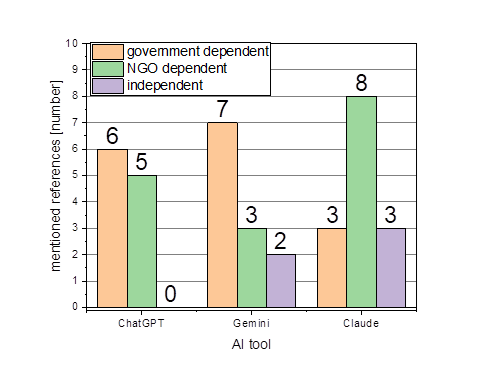
Artificial intelligence (AI) offers tools for text generation, text compression, literature search, image creation and translation. The current paper presents the application of three different AI tools (ChatGPT, Gemini and Claude) on these five areas in relation to the actually prominent topic “sustainability in the clothing industry”. These AI tools are used in their non-cost (free function) version. The main focus is the text creation with the aim to realize an essay which can be useful as a study work in a bachelor program. Even if there are differences in style and length of the essay created by the different AI tools, the quality is adequate with reasonable language and no typing errors. The lengths of the created texts are in the range of 366 to 1097 words. By text compression, a compression rate in the range of 41 to 83% is done. The results for translation can be described as good with no typing errors. In contrast, AI created images contain several significant language and typing errors. As drawback a bias in selection of sources and literature references by AI might be seen, which are quite often governmental or NGO owned webpages. For that reason, certain opinions might be more pronounced in the AI created texts. Considering this dominance of a certain type of sources, a careful check of AI created content might be useful and recommended. Finally, the presented paper is a case study for applying AI tools in academic writing and can support the evaluation of text creating for teaching purposes.
References
1. Gonzalez, T.; de la Rubia, M. A.; Hincz, K. P.; Comas-Lopez, M.; Subirats, L.; Fort, S.; Sacha, G. M. Influence of COVID-19 confinement on students’ performance in higher education. PloS one 2020, 15, e0239490. DOI: 10.1371/journal.pone.0239490
2. Gil-Fernández, R.; León Gómez, A.; Calderón-Garrido, D. Influence of COVID on the educational use of Social Media by students of Teaching Degrees. Education in the Knowledge Society, 2021, 22, 1-7. DOI: 10.14201/eks.23623 | e23623
3. Stecuła, K., Wolniak, R. Influence of COVID-19 pandemic on dissemination of innovative e-learning tools in higher education in Poland. Journal of Open Innovation: Technology, Market, and Complexity 2022, 8, 89. DOI: 10.3390/joitmc8020089
4. Mahltig, B. Conversion of a conventional to a digital lecture under the conditions of Covid19–an example from a bachelor lecture on finishing, dyeing & printing. Communications in Development and Assembling of Textile Products – CDATP 2021, 2, 173-186. DOI: 10.25367/cdatp.2021.2.p173-186
5. Mahltig, B. Comparison of conventional and digital lectures and examinations with respect to the conditions after COVID-19 period–an example for a bachelor lecture on textile finishing. Communications in Development and Assembling of Textile Products – CDATP 2023, 4, 284-293. DOI: 10.25367/cdatp.2023.4.p284-293
6. Lee, J.; Lee, S.; Lee, S. The influence of AI convergence education on students’ perception of AI. Journal of The Korean Association of Information Education 2021, 25, 483-490. DOI: 10.14352/jkaie.2021.25.3.483
7. Mulyani, H.; Istiaq, M. A.; Shauki, E. R.; Kurniati, F.; Arlinda, H. Transforming education: exploring the influence of generative AI on teaching performance. Cogent Education 2025, 12, 2448066. DOI: 10.1080/2331186X.2024.2448066
8. Garrel, v.G.; Mayer, J.; Webe, L.S. Wie Hochschullehrende künstliche Intelligenz im Studium nutzen – Ergebnisse einer bundesweiten Befragung. Die neue Hochschule – DNH 2026, 2026(1), 16-19. DOI: 10.5281/zenodo.18017027
9. Song, C.; Song, Y. Enhancing academic writing skills and motivation: assessing the efficacy of ChatGPT in AI-assisted language learning for EFL students. Frontiers in Psychology 2023, 14, 1260843. DOI: 10.3389/fpsyg.2023.1260843
10. Dong, Y. Revolutionizing academic English writing through AI-powered pedagogy: Practical exploration of teaching process and assessment. Journal of Higher Education Research 2023, 4, 52-57. DOI: 10.32629/jher.v4i2.1188
11. Bahari, A. Balancing syntactic complexity and clarity: the role of AI in enhancing academic writing proficiency. Saudi Journal of Language Studies 2025, 5, 271-290. DOI: 10.1108/SJLS-10-2024-0062
12. Rashid, S.; Malik, S.; Abbas, F.; Khan, J. A. Pakistani students’ perceptions about knowledge, use and impact of artificial intelligence (AI) on academic writing: A case study. Journal of Computers in Education 2025, 12, 1053-1078. DOI: 10.1007/s40692-024-00338-7
13. Jung, D.; Suh, S. Enhancing soft skills through Generative AI in sustainable fashion textile design education. Sustainability 2024, 16, 6973. DOI: 10.3390/su16166973
14. Mahadevan, J. Prompten statt denken? Die Auswirkung generativer KI-Nutzung auf studentische Lernfähigkeiten. Die neue Hochschule – DNH 2026, 2026(1), 8-11. DOI: 10.5281/zenodo.18017001
15. Danyaro, K.U.; Abdullahi, S.; Abdallah, A.S.; Chiroma, H. Hallucinations in large language models for education: Challenges and mitigation. International Journal of Teaching, Learning and Education 2025, 4(6), 13-19. DOI: 10.22161/ijtle
16. Peltekova, E.; Miteva, D.; Patias, I. Hallucination in LLM-based educational tools: Risks and solutions for reliable learning. Journal of Business Innovation and Governance 2026, 9(1), 22-37
17. Yeadon, W.; Agra, E.; Inyang, O. O.; Mackay, P.; Mizouri, A. Evaluating AI and human authorship quality in academic writing through physics essays. European Journal of Physics 2024, 45, 055703. DOI: 10.1088/1361-6404/ad669d
18. Sayam; Mostak, S.; Sarker, A.; Sultana, J.; Chy, M.S.R.; Das, S.; Dey, S.; Shil, S.; Bhowmik, S.; Shahjalal, M. Innovative approaches in textile functionalization with nanotechnology. Tekstilna Industrija 2025, 73(4), 11-26. DOI: 10.5937/tekstind2504011S
19. Ovi, F.I.; Shova, R.J.; Rahman, M.H.; Ghosh, N.C. Smart Textiles: An Interdisciplinary Overview of Advances, Applications, and Future Prospects. Biomaterials Connect 2025, 2(1), 1-10. DOI: 10.69709/BIOMATC.2025.148814
20. Gao, C.A.; Howard, F.M.; Markov, N.S.; Dyer, E.C.; Ramesh, S.; Luo, Y.; Pearson, A.T. Comparing scientific abstracts generated by ChatGPT to real abstracts with detectors and blinded human reviewers. NPJ digital medicine 2023, 6, 75. DOI: 10.1038/s41746-023-00819-6
21. Zhang, Y.Q.; Lykaki, M.; Alrajoula, M.T.; Markiewicz, M.; Kraas, C.; Kolbe, S.; Klinkhammer, K.; Rabe, M.; Klauer, R.; Bendt, E.; Stolte, S. Microplastics from textile origin–emission and reduction measures. Green Chemistry 2021, 23(15), 5247-5271. DOI: 10.1039/D1GC01589C
22. Klinkhammer, K.; Kolbe, S.; Brandt, S.; Meyer, J.; Ratovo, K.; Bendt, E.; Rabe, M. Release of fibrous microplastics from functional polyester garments through household washing. Frontiers in Environmental Science 2024, 12, 1330922. DOI: 10.3389/fenvs.2024.1330922
23. Blanckart, L.; Munasinghe, E.A.; Bendt, E.; Rahaman, A.; Abomohra, A.; Mahltig, B. Algae-based coatings for fully bio-based and colored textile products. Textiles 2025, 5(1), 1-17. DOI: 10.3390/textiles5010003
24. Rahaman, A.; Blanckart, L.; Hanelt, D.; Poller, M.J.; Heil, C.; Prova, S.M.; Ratovo, K.; Bendt, E.; Mahltig, B.; von Schwartzenberg, K.; Abomohra, A. Unraveling filamentous algae as a renewable bioresource for advanced moisture-absorbent innovative aquatic fibers. Bioresources and Bioprocessing 2026, 13(1), 33. DOI: 10.1186/s40643-026-01028-1
25. OpenAI, ChatGPT webpage. https://openai.com/de-DE/ (accessed 2026-03-24).
26. Google, Gemini app webpage. https://gemini.google/de/overview/?hl=de (accessed 2026-02-24).
27. Anthropic, Claude webpage. https://claude.ai/login (accessed 2026-02-24).
28. Niinimäki, K.; Peters, G.; Dahlbo, H.; Perry, P.; Rissanen, T.; Gwilt, A. The environmental price of fast fashion. Nature Reviews Earth & Environment 2020, 1, 189-200. DOI:10.1038/s43017-020-0039-9
29. Greenpeace International 2018, Green peace report: clothing industry shows progress in cutting hazardous chemicals, publications at 12. July 2018 https://www.greenpeace.org/international/press-release/17739/greenpeace-report-clothing-industry-shows-progress-in-cutting-hazardous-chemicals/ (accessed 2026-01-13).
Details


License
Copyright (c) 2026 Rebecca Schramm, Boris Mahltig

This work is licensed under a Creative Commons Attribution 4.0 International License.